.00 IDENTITY
SELEGILINE (l-deprenyl) — irreversible, selective MAO-B inhibitor. 10mg/day oral inhibits MAO-B almost completely. Stereoselectivity of metabolites: levo-form amphetamines are 2–3× LESS active CNS stimulators than dextro forms. Irreversible binding to MAO-B explains long-lasting steady-state concentration after repeated administration. Enzyme regeneration after irreversible inactivation usually occurs SEVERAL WEEKS after drug termination pharm-rev p.411 magyar2011.pdf. Parent drug UNDETECTABLE after oral administration; peak serum concentrations of metabolites within 0.5–2h. 94% plasma-protein bound, binds striatum, cortex, brain stem springer 10.2165/00002512-199101030-00006.
.01 MECHANISM / TANGLED
Psychic energizers sought via known antidepressant effect of MAO inhibitors; serotonin + noradrenaline = specific MAO-A substrates → explains antidepressant AND blood-pressure-increasing effects of MAO-A inhibitors; ß-phenylethylamine FIRST identified as MAO-B substrate, selective MAO-B inhibition increases this biogenic amine; dopamine LATER revealed as MAO-B substrate too — actually a substrate of BOTH MAO isoenzymes. Main pharmacological influence on dopaminergic neurons: INCREASED SENSITIVITY to physiological and pharmacological stimuli, partially from MAO-B inhibition + inhibition of DA uptake. Increases nigrostriatal dopamine; may protect neurons against free-radical damage and possibly exogenous neurotoxins; inhibits dopamine reuptake from synaptic cleft; selectivity means 10mg/day does NOT prevent breakdown / exacerbate indirect pressor effects of dietary amines (tyramine) — devoid of 'cheese' effect inhibitors-of-mao-b-1993 p.201. Post mortem (selegiline+levodopa recipients): ~90% inhibition of nigrostriatal MAO-B activity springer 10.2165/00002512-199101030-00006. Repeated administration: basal dopamine UNALTERED; basal DOPAC decreased >80%; DOPAC reduced >50% after acute administration, even more on day 8 → DECREASED DOPAMINE TURNOVER springer 10.1007/s00210-001-0492-z. Repeated high-dose: stable long-lasting steady-state concentration of inhibitor — explained by irreversible MAO-B binding magyar2011.pdf.
.10 PARKINSON'S
1983: FIRST report of prolonged life expectancy for selegiline-treated PD patients springer 10.1007/s00702-019-02082-0. 1989 (54 patients): 10mg/day delayed need for levodopa by ~8 MONTHS — first such report. Clinical trials UNEQUIVOCALLY proved efficacy of selegiline monotherapy in early PD; symptom improvement + delays levodopa introduction by 3–9 months + reduces necessary levodopa dose. Numerous animal & cell-culture studies: protects against various neurotoxins, reduces oxidative stress, neurotrophic + anti-apoptotic effects. CRITICAL CONTROL: substitution of selegiline treatment by its metabolites (mixture R-methamphetamine + R-amphetamine) → LOSS OF CLINICAL EFFECT → amphetamines contribute NOTHING to clinical benefit in Parkinson's disease springer 10.1007/s00702-019-02082-0.
.11 DEPRESSION / STS
High dosages (up to 50mg daily) successfully used in treatment of depression; above 20mg daily MAO-A also significantly inhibited inhibitors-of-mao-b-1993. Transdermal system (STS) developed to AVOID first-pass metabolism: absolute bioavailability 4% (oral) → 73% (STS). ~33% inhibition of MAO-A in human brain after 28-day STS 6mg/day. Short-term placebo-controlled 6–8 week studies in major depressive disorder: statistically significant antidepressant activity; NO hypertensive effect (cheese effect) observed EVEN WITH tyramine-enriched diet springer 10.1007/s00702-019-02082-0. Atypical depressives: even at high dosages, FEWER side effects than nonselective MAOIs pubmed 6430257 quitkin1984.pdf.
.20 METABOLISM
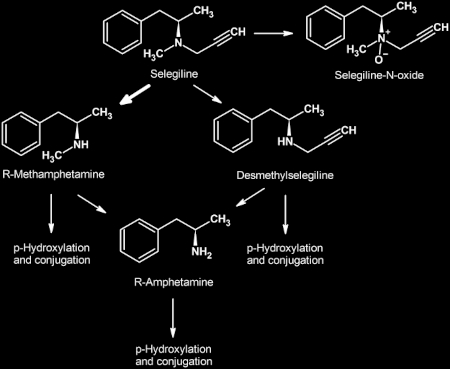
Oral administration → EXTENSIVE first-pass metabolism; systemic exposure of metabolites CONSIDERABLY HIGHER than parent compound. R-methamphetamine = primary metabolite, partially converted to R-amphetamine. Also metabolized to L-methamphetamine, L-amphetamine, demethyl-selegiline; may account for euphoria and insomnia seen in MANY patients. Stimulating properties may produce INSOMNIA if administered later than mid-afternoon (p.316); selegiline and tranylcypromine share amphetamine-like stimulant effect producing agitation or insomnia (p.409) illustrated-reviews-pharmacology. Pharmacokinetic analysis LIMITED because of extensive rapid metabolism springer 10.2165/00002512-199101030-00006.
.21 SAFETY / INTERACTIONS / MESS
CHEESE At PD dosages (5–10mg daily) does NOT significantly potentiate tyramine-induced hypertension; lowers blood pressure; free from "cheese effect"; free from liver toxicity (another problem of some irreversible MAO inhibitors) springer 10.2165/00002018-199819010-00002. Most frequent adverse events (monotherapy): insomnia, nausea, benign cardiac arrhythmias, dizziness, headache. Low tyramine diet RECOMMENDED if combined with nonselective MAO inhibitors or moclobemide (selective reversible MAO-A inhibitor). Moclobemide + selegiline: well tolerated BUT supra-additive potentiation of tyramine pressor effects → dietary restriction of tyramine necessary during such combination therapy springer 10.1007/BF00226327. SSRIs: concomitant use with citalopram etc. seems well tolerated (generally fewer interactions than fluoxetine).
.30 PERIPHERAL EFFECTS
Antioxidant activity; reduced fat accumulation in liver of rats on lipid-rich diet. Cytoprotective in rabbit model of CHRONIC HEART FAILURE: reduced plasma norepinephrine, cardiac oxidative stress, myocyte apoptosis springer 10.1007/s00702-019-02082-0.
.40 SOURCE INDEX
[001] repeated high-dose selegiline, behaviour, striatal transmission, TH mRNA [002] selegiline: a molecule with innovative potential [003] selegiline drug evaluation [004] safety of selegiline (deprenyl) in PD [005] tyramine pressor sensitivity, moclobemide+selegiline [006] l-deprenyl in atypical depressives [007] inhibitors-of-monoamine-oxidase-b-1993.pdf (p.201) [008] illustrated-reviews-pharmacology.pdf (pp.316/409/411) [009] quitkin1984.pdf [010] magyar2011.pdf ██ERR█
.50 ANNEX // METABOLIC PATHWAY █▌▐ [FIG-01]